Earlier this year, my family and I took a trip back in time to a defining period of the 20th Century…then known as the War to End All Wars… now referred to as the First World War… as we headed to Ypres in Belgium to visit the battlefield and trace the relatives who never returned from The Western Front.
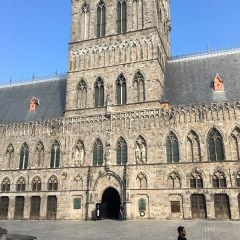
The Old Cloth Hall, now the In Flander’s Field Museum
Let’s start by saying that Ypres is a delightful, surprising town providing all visitors with a warm welcome. Yet it’s also a deceptive place. Sitting in the market square on a sunny spring evening, drinking a bottle of beer you’d be forgiven for thinking it had stood firm for centuries as you bask in it’s medieval architecture.
However, like most towns and cities along the Western Front it did not escape unscathed from ravages of war… in fact by 1918 nothing in the town stood at over 1 metre tall. Ariel photographs in the Hill 62 museum emphasis the destruction, with buildings demolished and even roadway vanished.
Instead. It’s current façade is testament to the determination of residents returning post war, who fought those who wished the demolished town to remain a constant moment to the cost of war (Winston Churchill) and instead lovingly rebuilt it, to pre-war specifications representing a desire to return to better times.
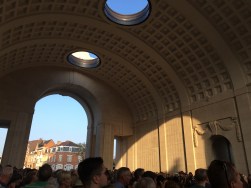
The Last Post Ceremony at The Menin Gate
That’s not to say that the ravages of war have been lost to time, in the town the signs remain from the names of cafes (The Tommy), the brilliant In Flander’s Field museum and specifically the Last Post ceremony at the Menin Gate which has been conducted constantly for almost 100 years, the only break occurring during the German occupation of World War 2.
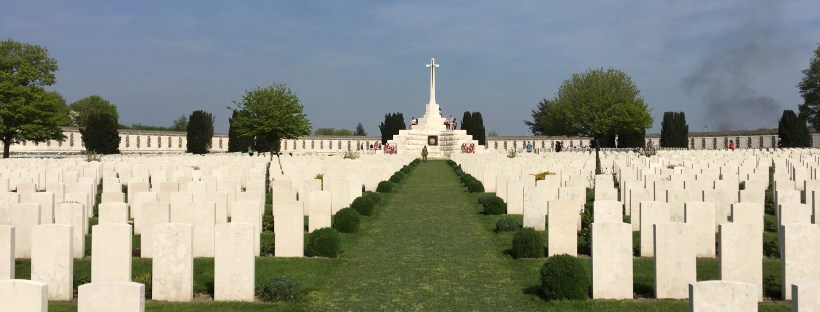
Travel outside of the town and the physical signs are more evident, shells appear on the roadside, placed there for bomb disposal units by farmers who ploughed them up during the harvest, cemetery’s populated by the infamous white headstones of commonwealth graves appear frequently, and craters remain from detonated shells and in the case of the Peace Pool, from mines detonated under German lines.
In the sunny days of our weekend visit it was often hard to picture just what life must have been like for the troops stationed in the trenches from 1914 – 1918 and yet the poignancy of the location continues to strike you, even driving around.
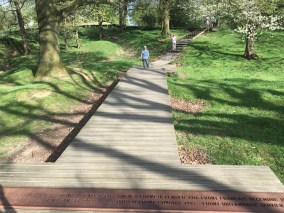
The distance between the Allied and German lines at Hill 60
In particular a Centenary project which saw trees planted along both the Allied and German lines, the former marked by blue posts and the latter red, highlights the reality of the situation. When you read or hear about No Man’s Land, you imagine it to be a vast, unpopulated area, driving around, it’s scary to realise just how close the two sides were, in some cases less than 10 feet separate them.
Ypres is also poignant for it’s connection to World War 2 as well… visiting Bayernwauld a preserved German trench you’re confronted with a sign informing you that this was where Adolf Hitler served during World War 1, while a visit to Langermark, the only German cemetery in the area, revealed he had visited in a propaganda move during the World War 2.
I think it would be easy as a Brit, or indeed anyone on the allied side to avoid visiting these German landmarks, instead choosing to focus on the allied locations, however I would strongly recommend making the trip.
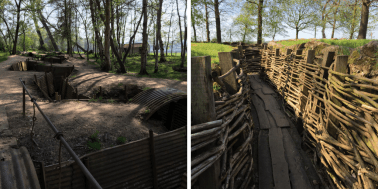
Hill 62 preserved trench (left) and Bayernwauld (right)
Bayernwauld provides a fascinating insight into the difference between the Allied and German approaches to trench warfare, especially when partnered with a visit to the Hill 62 museum where a British communication’s trench has been preserved.
While Langermark cementery stands as a stark reminder that the German troops were just men, who fought and died, just as those on the allied side did, following orders and suffering as a result. It also stands out in contrast to the allied cemeteries, which are light and bright, as it’s much darker, featuring granite headstones, marking graves of anywhere between 8 and 20 soldiers, following a decision to reduce the number of German cemeteries after World War 2, when Germany’s financial situation made it difficult to maintain them.
An emotive and moving trip, it also provides a strong learning experience, as no matter how much you think you know beforehand, confronting the reality will always change your perception.
 Elle's Scribbles