
Ever since the Second World War ended, 75 years ago, historians and commentators have pulled apart the Bombing War, examining it in exacting detail and passing their knowledge onto the general public through books, documentaries and podcasts. It’s reached the point where you’d think nothing new could be added to the conversation.
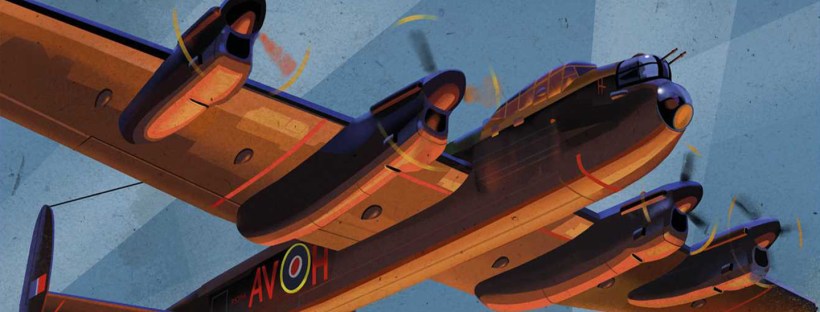
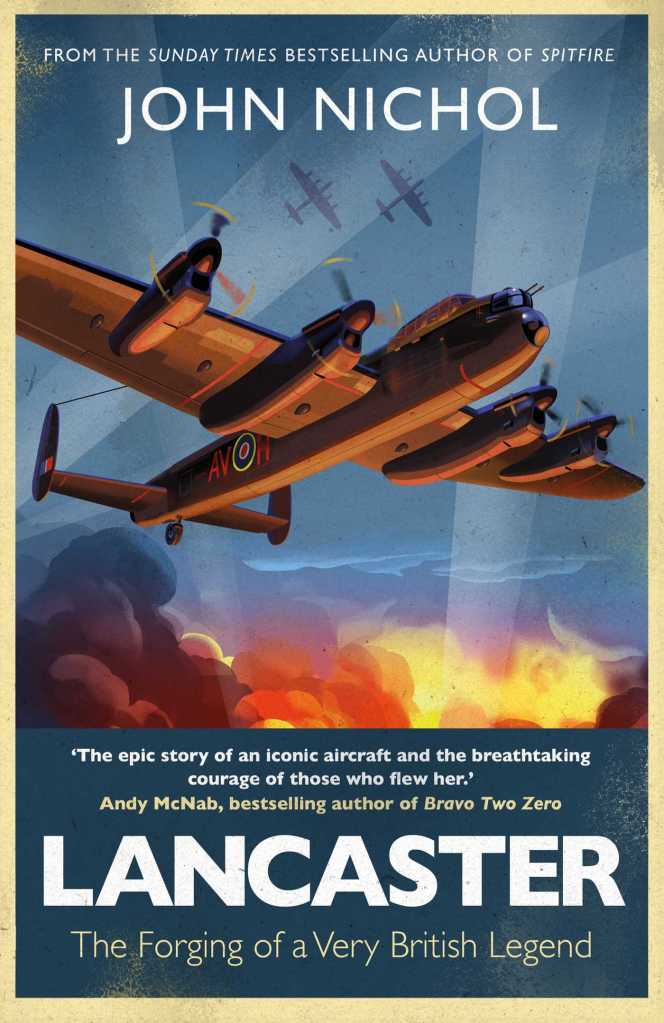
Yet ‘new’ is exactly what John Nichol delivers, in ‘Lancaster: The Forging of a Very British Legend’, as he continues on from his previous work ‘Spitfire: A Very British Love Story.’ To explore the war from the perspective of a single aircraft and the impact it had, not just on the war, but on the men who flew her, the people who built her, and those who suffered as she flew overhead.
As reader’s we’re taken inside the cockpit of the iconic aircraft on bombing runs over Germany, we accompany pilots that have been shot down as they are taken prisoner or escape back to Britain with the support of local people, and we stand with a little girl on the side of the road as she waves goodbye to her father for last time, proud of the uniform he wears, the job he does and the aircraft he flies.
These stories are what make this work so special, and while anyone can interview a veteran, or their families, John brings a unique perspective to these conversations, and subsequent writing as a fellow aviator, and for many of the veterans featured in Lancaster, as a fellow prisoner of war. He understands these men in a way others simply can’t and creating a sensitivity and understanding that is evident throughout the book. As such, I feel like we, the readers, get a better insight into what life was like working in, alongside and under these magnificent flying machines.
The bombing war has always been highly controversial, and John doesn’t hold back in dealing with it, revealing what life was like on the ground for the German’s trapped in the cities, as wave upon wave of Lancasters flew overhead. He confronts the horrors, for all those involved and doesn’t shy away from the impact on Dresden, Hamburg or Berlin. But at the same time he carefully and considerately lays out the arguments for why the bombing campaign was considered necessary at the time, not least the fact that WW2 was a total war, and crucially explains that we shouldn’t hold the actions of leaders and politicians against the thousands of men who risked their lives, and in particular the 57,205 men who never returned.
‘Lancaster: The Forging of a Very British Legend’ isn’t an easy read, as we’re confronted with the harsh realities of what the war was like for those who just wanted to do their bit for King and Country, but that is exactly the reason why it should be read. After all, in the words of George Santayana; ‘Those who cannot remember the past are condemned to repeat it.’
E
 Elle's Scribbles