
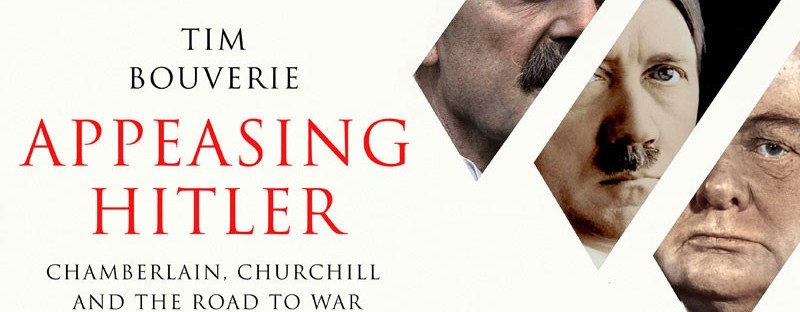
When it comes to history, the Second World War is arguably the period that interests me the most. If you were to look at my historical book shelf, it dominates. Yet, I must acknowledge that my understanding of the period leading up to the declaration of War on September 3, 1939, is limited at best. In truth it extended only to Chamberlain’s famous paper waving and “Peace in Our Time” declaration, which until recently I believed happened in the same moment.
That was until I read Tim Bouverie’s in depth exploration of the Appeasement process that dominated the 1930s.
Stretching from 1933 until the Dunkirk Evacuation in 1940, ‘Appeasing Hitler: Chamberlain, Churchill and the Road to War’ explores the British, and French, attitudes to the Third Reich and the factors which influenced the policy of appeasement, both nations favoured during the 1930s.
By it’s very nature, involving a heavily political focus, it would be easy for Bouverie to become bogged down in the technical minutia of the debates and lose his reader. Instead, he carefully presents the back and forth, occasionally underhand, nature of complicated politics in a manner accessible to even the most politically uneducated of readers.
Balancing the views of both appeasers and anti-appeasers, Bouverie takes the reader on the journey through the various moments Europe teetered on the brink of War, including the 1935 Abyssinia Crisis and the Spanish Civil War, as well as the various moments Nazi Germany’s expansionist plans threated peace (invasion of the Rhineland, the Anschluss, the return of the Sudetenland and the final tipping point, control of Danzig).
Bouverie carefully builds the political picture at each of those moments, to show the pressures each leader was facing when making decisions as to what could, or couldn’t be conceded. Detailing intelligence reports, party loyalty, the level of dissent in government, the status of rearmament, news reports and perhaps most crucially of all public opinion, as expressed to/gathered by Mass Observation. It is these details, coupled with character portraits of the key figures (Chamberlain, Halifax, Daladier and Hitler) that allows the reader to draw their own conclusions about whether or not the approach taken at the time was, correct in the moment.
It is the insight into the personal, as well as the political, that is what makes this work so engaging. Bouverie has chosen to include exerts from personal letters between key figures and their friends and family, alongside political documentation and news reports, allowing readers a unique insight into the minds of leaders during times of great risk and showing those instances where personal opinion had to bow to political pressure or vice-versa.
For me, the letters Neville Chamberlain exchanged with his sisters were particularly interesting, as they served to humanise a man who is so often painted as irresponsible and blind to what was happening in Germany.
Hindsight can be a wonderful thing but it can skew our judgement. 90 years later, it is easy to see why appeasing Hitler wasn’t the best course of action in the 1930s and that Churchill had it all right from the start. At the time, as this book so carefully details, it wasn’t so black and white… the situation was a lot more grey.
While it’s easy to get carried away in wanting to read more about the feats of courage and bravery that saw Hitler defeated, I think it’s vital that anyone interested in the Second World War take the time to understand the events that brought us to that seminal moment in September 1939. When appeasement ended and conflict became the only acceptable option for politicians on both sides of the Channel.
Oh, and for those who are interested, while they happened on the same day, Chamberlain waved the famous paper, at the airport after his flight from Munich, but made the “Peace in Our Time” declaration from a window at Number 10, Downing Street, mimicking the actions of previous Prime Minister, Benjamin Disraeli who declared he had brought back “a peace I hope with honour” following the 1878 Congress of Berlin, which reorganised the Balkan Peninsula after the Russo-Turkish War.
E
 Elle's Scribbles