
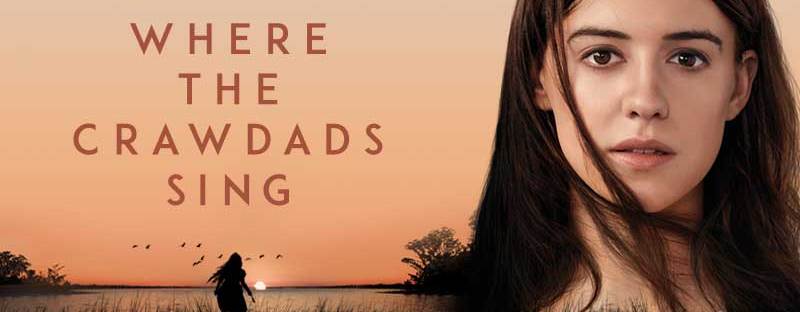
If ever a film had a recipe for success it’s Where the Crawdads Sing. Based on the best-selling novel of the same name, starring Daisy Edgar Jones (fresh from her breakout role in Normal People) and produced by Reese Witherspoon. To steal a sports analogy, it should have been a home run.
Despite the star ingredients, the film leaves a disappointing after taste, at least for those who’ve read Delia Owen’s novel.
Central to the novel is the beautiful, languid quality of the narrative, which matches the life beat of the marsh, allowing the characters to breathe, and the reader time to connect and understand, what’s behind their individual motivations. This quality is missing from the film, where everything feels rushed, resulting in an emotional disconnect between the audience and the characters.
Adapting a novel is never easy, especially for a cinematic release, as cuts are necessary to meet the limited runtime. In this case fitting almost 400 pages into 125 minutes.
Glossing over, or completely skipping key narrative elements such as Kaia’s difficult childhood, as well as her abandonment and reconnection with Tate, not only minimises the emotional impact, but also removes vital complexities reducing a story full of depth to a superficial tale, that fails to pack a punch.
In truth, the film is most let down by the decision to abandon the novel’s chronological narrative, and use the final act courtroom trial as a framing device instead.
In the right circumstances, a framing device can be incredibly effective, but here it is simply reductive. Removing tension and drama by throwing away a climatic moment from the story in the film’s opening scenes, the device not only forces the narrative through a series of flashbacks, but also removes focus from the trial itself, as the defence becomes disjointed instead of slowly building on each point to a strong conclusion.
Arguably, the only positive of the framing device is that it increases the presence of David Strathairn, as lawyer, Tom Milton, an actor I could happily watch all day.
Narrative problems aside, Where the Crawdads Sing, also has a problem with chemistry… more specifically a lack of it. Neither the true love relationship or the dangerous fling, which are vital to the story, are believable. If you wish to be forgiving, perhaps Daisy Edgar Jones was attempting to show Kaia might be reticence to commit to someone after her childhood abandonment. Yet, as the relationship(s) progress, explained by a voiceover, an overwhelming sentiment of ambivalence covers everything.
I appreciate that Kaia and Tate’s love would never be described as overly passionate, but it was full of strong, often silent emotions. Not something ever expressed, or even hinted at, in the film.
Also a personal bug bear of mine is that Daisy Edgar Jones’ Kaia, is too clean, too neat, too tidy. Despite running through an actual marsh, barely a hair is out of place and her clothes are pristine. Kaia belongs to the marsh, she is supposed to be dischellved, with twigs in her hair and mud on her face. It could have been artfully done, to enhance Edgar Jones’ natural prettiness, but it’s another vital element that’s missed.
It’s not all bad. The cinematography is mesmerising and manages to capture the beauty of the marsh, allowing audiences to appreciate Kaia’s world and better understand why she doesn’t want to leave.
While those who haven’t read Delia Owen’s novel might find some enjoyment here, everyone else should give it a miss, cross it off as a rare misstep by Reese Witherspoon’s Hello Sunshine production company, and opt to re-read the book instead.
E
 Elle's Scribbles