
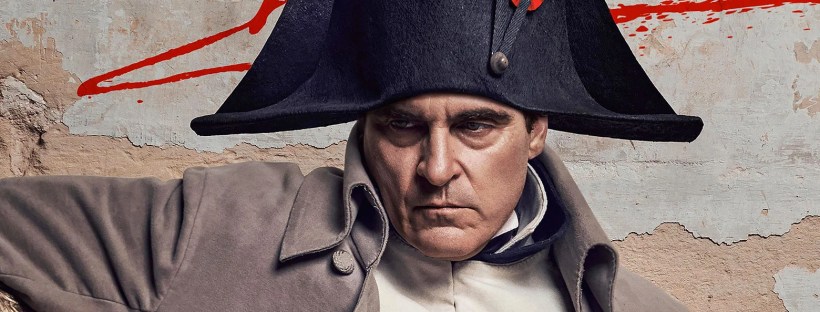
Napoleon Bonaparte is a figure that has loomed large in the history of Europe. As Emperor of France, he ruled over an empire that stretched from the Spanish coast to the borders of Russia (and a little beyond). As a man his life was filled with political intrigue, family drama and a passionate, enduring love, alongside years of military campaigned, both successful and unsuccessful in their outcomes.
All of which, should, when brought to the big screen for a new generation, combine to create an engaging, exciting and enigmatic drama.
Or, so you would think…
Unfortunately, Ridley Scott’s take on Napoleon is missing some crucial ingredients.
Scott is certainly ambitious in his scope for the film, taking audiences from the execution of Marie Antoinette in 1793, to Napoleon’s final exile in 1815. However, trying to cover 22 years in 3 hours leaves a lot to be desired as the film jumps from key moment to key moment, without build up, explanation or room for the drama to breathe.
Not only does this leave you with the sensation of whiplash, but it also means key characters are regulated to bit parts, with only the lucky few introduced to audience via text on the screen.
This means Scott is missing the crucial ingredients of political intrigue and family drama.
Napoleon’s brother appears briefly towards the beginning of the film, before disappearing with no reference made to his time as either King of Naples or King of Spain. His sisters don’t get a look in, and neither do his Marshalls, many of whom were like brothers to the Emperor, with several becoming in-laws by marriage.
This lack of family and friends outside of Napoleon’s mother and Josephine, means the film lacks emotional follow through, with the significance of key moments, such as Ney’s ill advised cavalry charge to save his beloved Emperor at Waterloo is lost.
Meanwhile, the political intrigues that abounded in this age of revolution are either ignored or speed through. What’s more Napoleon is reduced to a bit part in the political fray, with his rise to power depicted as almost an accident of circumstance, rather than the calculated move it was.
Through the film, Joaquin Phoenix’s portrayal of Napoleon is problematic. Rather than the dominating, decisive conqueror, he is shown as weak and ineffective. He lacks the charism or authority that not only saw so many soldiers a devote themselves to Napoleon’s cause, but which also won over numerous politicians, ambassadors and world leaders. In fact, Phoenix has done the impossible and made the towering figure seem dull as dishwater… an impressive feat.
Napoleon’s relationship with Josephine not only dominates the narrative, but is also show to dominate his decisions. Scott would have us believe that Napoleon rushes home from his Egyptian campaign because he must confront Josephine about her affair… rather than showing how he had been carrying on his own affairs while on campaign and returned to France when the political problems in Paris had pushed the country to the brink of ruin, which opened the door to his own power-grapping coup. But, I suppose if Scott had depicted this, he would have had to have shown Napoleon as the political intriguer and strategist that he was.
Thanks to their love letters, the romance between Napoleon and Josephine has captured imaginations for centuries. It certainly takes centre stage in this retelling of their lives. But where there should be passion, desire and chemistry… there is nothing. I also found the decision to use Dawn from the 2005 Pride and Prejudice soundtrack as the imperial couple’s love theme strange and off-putting. Not least because it’s gentle tone rarely matched the mood of the scene.
Putting aside the lack of chemistry with Joaquin Phoenix, Vanessa Kirby delivers a fine performance as the fiery, yet resigned, Josephine. However both her age (she’s about a decade too young to play Josephine) and the mad pace of the narrative, means the drama around Josephine’s inability to provide Napoleon with an heir and secure the succession, as well as the couple’s subsequent divorce for the sake of France, fall flat. Once again the relentless pace, and confusing time jumps leave no room for the emotions to build and breathe.
No commentary on Scott’s Napoleon is complete without discussing the battle scenes. After all, Napoleon is arguably known as one of the best military tacticians to have ever taken to the film… with his time as an artilleryman providing him with a fresh perspective, different from that of his opposing generals.
And yet, despite this being such a huge part of Napoleon’s life and history, Scott ignores it. with the few battles shown given mere minutes of screen time… and most of those are inaccurate depictions. Toulon was a city under siege, not one where an enemy officer could just waltz in and ride around to have a look, nor did Napoleon lead a cavalry charge at Borodino and there were no prepared infantry trenches at Waterloo… to name just a few of the errors made. And, that’s without mentioning key events which are ignored completely, including the Italian Campaign, the Peninsular War in Spain and the Battle of Trafalgar.
Napoleon is a fascinating figure and I, for one, have always wanted to see a strong cinematic depiction of his life. Unfortunately, I will have to wait a little longer as Ridley Scott’s Napoleon, leaves a lot to be desired… a lesson, perhaps for future filmmakers tackling biographical projects that wile some liberties when translating life to screen are occasionally necessary, don’t stray too far from the source or you risk leaving your audience disappointed and frustrated.
E
 Elle's Scribbles