
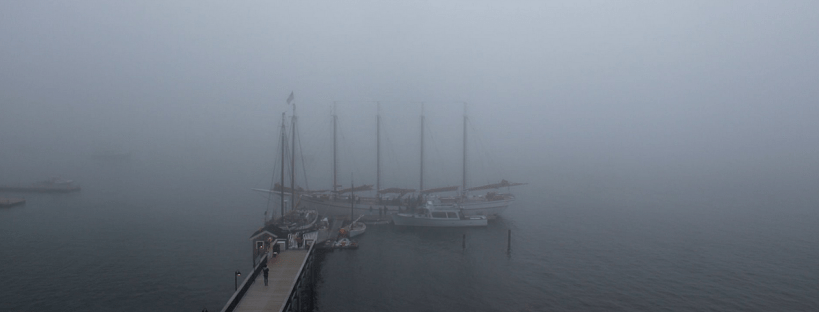
A dense fog had descended over the harbour, and the few souls scurrying along the docks could barely see their hand in front of their faces. Long mournful sounds echoed across the water as those ships not tied alongside, sounded their fog horns, a warning to fellow sailors. Even the lighthouse’s powerful bulb struggled to cut through the soup.
For the town’s inhabitants, it was a night to lock their doors, light their fires and snuggle close with their loved ones. Only the hardy few ventured to the local pub, propping up the bar and regaling the owner with tales of previous foggy nights. The owner only listened with half an ear as he cleaned glasses, it wasn’t the first time he had heard these tales and it wouldn’t be last. Every fog they were trotted out, embellished, examined and pulled apart before being put away until the next fog blew in.
As the night drew on, and fires were banked down for sleep, fishermen switched on the shipping forecast and studied their charts, hoping the fog would lift before the morning so they could get out, check and reset their pots, cast their nets and bring home a catch. A day lost could be devastating, especially at this time of year, but they can’t control the weather and if the fog remained in the harbour, so would their boats.
One by one, the lights went out, and blankets were pulled around shoulders. The town settled, lulled to sleep by the chimes of distant fog horns.
As the clocks struck two, just beyond the harbour walls, a small boat was lowered from a passing cargo ship and cut loose. Onboard, the three occupants, silently and efficiently set about their business, striking oars and turning towards the shore.
The foggy night might keep everyone else tucked up inside but for these men the conditions were perfect.
Steadily, they rowed onwards, the man on the tiller making occasional adjustments to their course. He knew these waters from his childhood and didn’t need to see to navigate his way into the harbour.
When he was eight years old, his grandfather, a lifeboatman, had brought him out beyond the harbour, blindfolded him and taught him to feel his way home. They did this for several days until he was sent out alone to prove his knowledge. His mother had been furious when she learnt what happened, raging at both him and his grandfather about how foolish they’d been, how easily he could have been hurt, and the damage he could have done to the family’s only boat, a vital source of income.
He’d sat there with his head bowed under her tirade, until his grandfather had stood and faced his mother. “I did this to protect the boy. I’ve seen far too many men wrecked outside that wall because they couldn’t see a way back in, I won’t see my grandson the same. Storm, fog or the blackest night won’t stop him from making it home.”
With his piece said, and leaving the boy’s mother speechless by the simple logic of his argument, the old man walked out of the room and down to the pub.
16 years later, the helmsman kept them on course as the oars dipped in and out of the water. Seamlessly, despite the fog, they passed through the gap in the sea wall that formed the harbour’s entrance and turned towards a small slip in the corner.
Bumping gently along the rock, the oars were stowed and the three men slid quietly over the side to push the boat further out of the water. Not a word passed between them, even in the small hours of the night they feared attracting unwanted attention.
Quickly and efficiently, the little boat, was emptied into a nearby fisherman’s wharf. Creating a chain, the three men passed the boxes out of the boat. Inside the wharf, the helmsman stacked them neatly in a darkened corner before covering them with discarded nets. To any curious individual it would like an assortment of fishing gear waiting for repair, or at least that was the helmsman’s hope.
Centuries ago, the helmsman’s Great-Great-Great Grandfather had smuggled casks of wine and rum, boxes of spices, tea and cocoa, as well as rolls of silk and cashmere into the caves that surrounded the town. It was a livelihood passed down through the generations, although now, under the helmsmen, things were more brazen, with the goods brought directly into the harbour. But then electronics, car parts and cartons of cigarettes tended not to hold their value in damp caves.
The job done, the three men silently re-boarded their little boat and glided back through the harbour entrance and around to the next bay where the cargo ship waited to collect them before continuing to it’s next port.
The fog remained the following morning, and while most of the town’s fishermen, resigned to the loss, took advantage of the extra hours in a warm bed, a select few made their way down to the wharf. Pulling away the nets and pots, the group paused to examine the nights haul, appreciating the helmsman’s gift for knowing what was likely to sell, and sell well. In a reverse of the night’s activity, these men now formed a chain, loading the goods into a van, before heading out of town.
As the clocks moved towards midday, the sun began to burn through the fog and touch the town again. Fishermen ventured down to the harbour to prepare for the next days sail, grateful to have only lost a day of earnings. Around the same time, somewhere on the road out of town, the van drew to halt in a layby, and the goods were again passed over to another party. This was the smuggler’s middleman, who took a share of their cut but always ensured the sale of goods resulted in high profits for all.
A few evenings later the pub was full of hustle and bustle, the owner conducting a roaring trade with a group of men who’d found their pockets a little heavier despite a day’s fishing lost. A single cut from the smugglers profit remained in the wharf’s safe, for when the helmsman next visited his mother, who stilled lived in the little cottage where she had once raged at a boy and his grandfather.
E
 Elle's Scribbles
Fantastic. I enjoyed the read.
Get Outlook for iOShttps://aka.ms/o0ukef ________________________________
LikeLike