
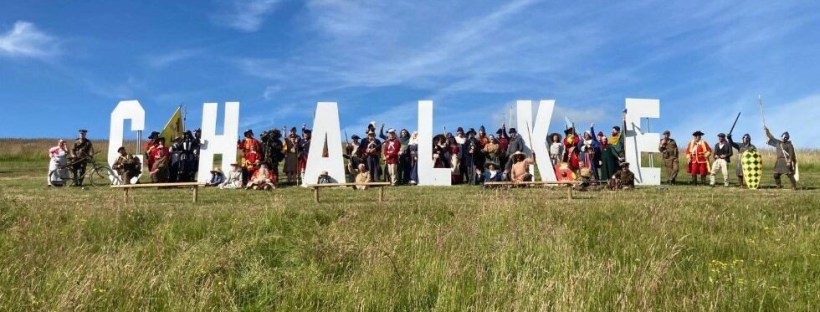
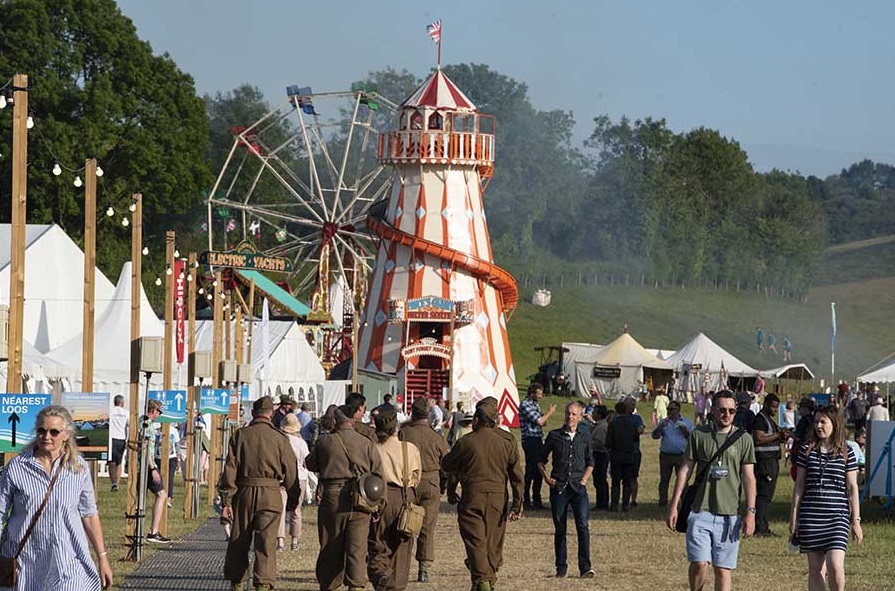
A staple of my summer event calendar is the Chalke History Festival, a mix of re-enactments, talks and performances that can entertain for a day or a week, depending on budget. Spending too much money in Waterstones, watching WWII artillery in action and exploring a Royal Naval Commando Beachmaster station were all highlights. However, it was the question posed by the first talk of the day, that really captured my attention.
Taking to the stage, Charlie Higson chaired a panel discussing ‘1066 And All That! Important Dates in History.’ Charlie prefaced by the talk by asking panellists Alice Loxton, Helen Carr and Al Murray, what dates in history did they think should be taught in schools?
Helen kicked things off by proposing the Battle of Bannockburn in 1314, as a significant moment in Scottish, English relations, while Al suggested the Great Fire of London in 1666. Alice’s submission was the destruction of the Elanor Crosses during the English Civil War, highlighting the confusion of the general population who had used them as key navigation markers on the route between Lincoln and London for more than 3 centuries.
Charlie choose the more recent date of 1953, as it saw the birth of two British icons, with Queen Elizabeth II crowned in the first televised coronation, and the publication of Casino Royale, Ian Fleming’s first James Bond novel.
As the talk came to an end, I was left wondering what date (or dates) I would choose…

After much consideration, the first area I would propose would be The Tudors. Now, I know it can be argued that this is already taught in schools, however I counter with, not the interesting (or significant bits). Sure, the six wives make a nice rhyme (and a great musical) but instead of focusing on ‘divorced, beheaded, died’, let’s instead focus on the impact of that divorce – the formation of the Church of England, and the Dissolution of the Monasteries.
In a very short period of time, the rhythms of life for England’s population were upended, the country’s relationship with Europe changed drastically and it’s outlook became more global. In fact, an argument could be made that the seeds of the British Empire were sown in this period, as the Protestantism of England led to the country’s ex-communication by the pope. This in turn closed access to the ports of it’s traditional trading partners (Catholic Spain, France, etc) and saw explorers like Francis Drake, sail the world looking for new opportunities, which in turn led to the formation of the East India Company towards the end of Elizabeth I’s reign. All of which is surely far more interesting than Henry VIII’s love life.
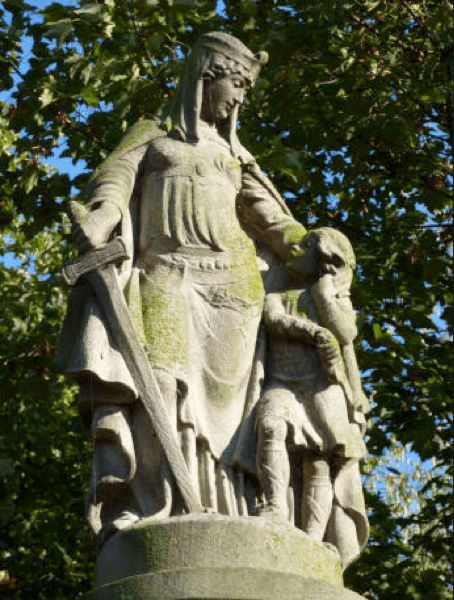
Speaking of Kings, its too easy today to start counting from the Norman Conquest in 1066, with many schools jumping from the Norman’s to Hastings with a slight detour via the Vikings. This skips significant periods of history, not least the formation of England, as envision by Alfred the Great and secured by his grandson, Athelstan. Uniting the seven Saxon Kingdom’s of Wessex, Mercia, East Anglia, Sussex, Essex, Kent and Northumbria was no easy matter, achieved through a combination of violence, diplomacy and marriage.
Studying this process would also enable more people to learn about Aetheflaed, Lady of Mercia, who as Alfred’s daughter was given in marriage to unite Wessex and Mercia. However, with the decline of her husband’s health, and his eventual death, Aethelflaed ably ruled Mercia alone, winning battles and, shortly before her own death, the loyalty of York’s Vikings. Female rule is a such a unique event in early medieval history, that for me, Aethelflaed is reason enough for this period to be explored as part of the history curriculum.
Before I present my third and final suggestion, here are some honourable mentions that are also worth consideration; The White Ship Disaster, Northern Ireland and the Troubles, the Second World War in the Pacific, The Treaty of Versailles and the end of the British Empire.
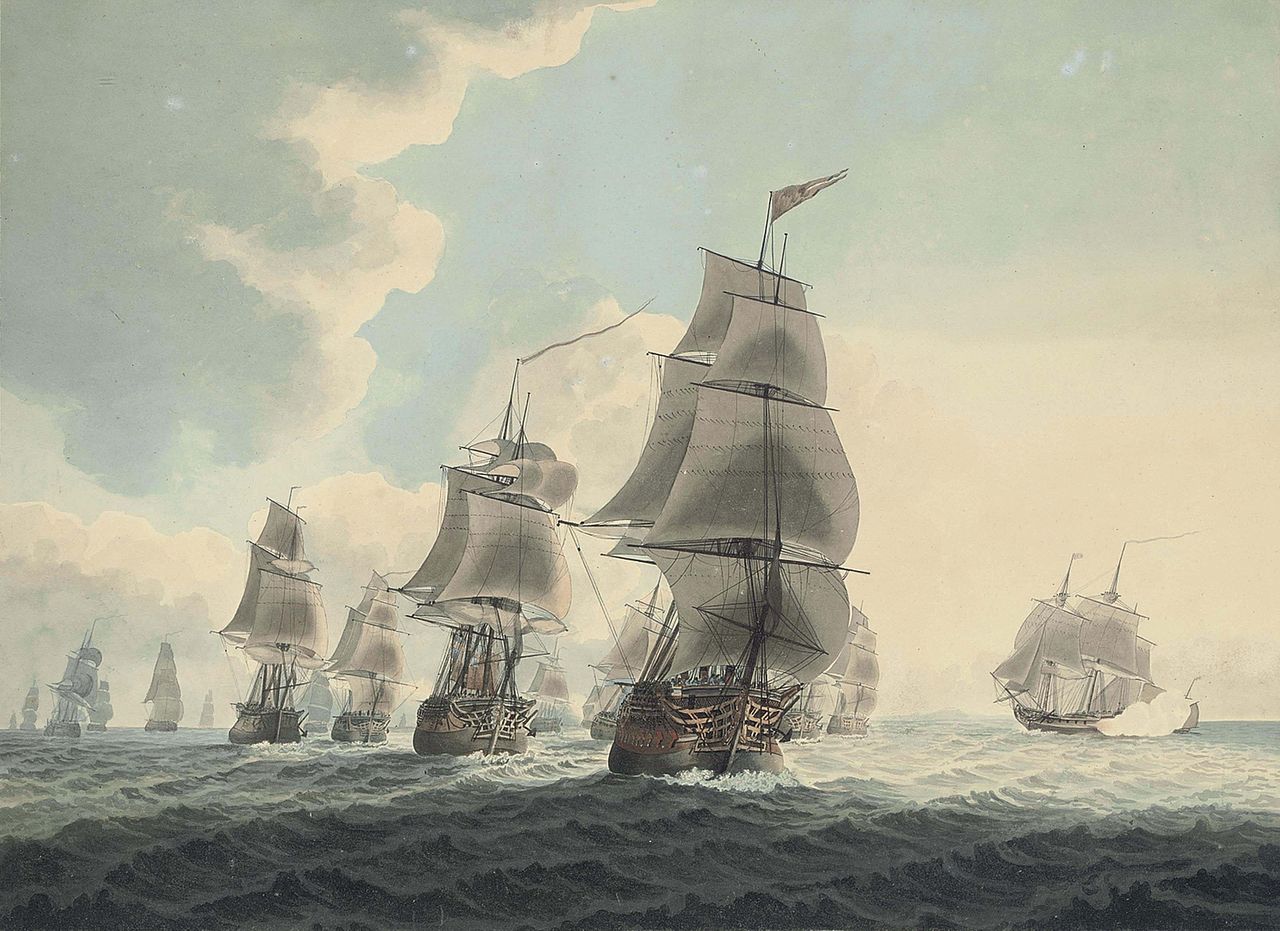
Finally, I propose that as an Island nation, more time should be spent exploring our naval history, both military and civil. Discuss important battles such as the Spanish Armada, Trafalgar and Jutland, in addition to the actions of individual commanders like Admiral’s Cochrane (Napoleonic era), Ramsay (WWII) and Cunningham (WWII). Then follow the adventures of explores including Francis Drake, James Cook and Ernest Shackleton, as well as the trade routes and patterns that helped make such a small nation so powerful and prosperous.
Talks which stir ideas and prompt further reflection, as to me, always the most interesting, whether at a festival, in a theatre or online. My suggestions of important dates in history to be added to the school curriculum already differ from those of the panellists, and would, I’m sure differ from those of my friends and colleagues if I were to ask them for their thoughts.
Ultimately, the most important thing is that while it’s impossible to cover all the important dates, that parts of history continue to be taught in schools. After all, as my history teacher often reminded his classes, ‘those who cannot remember their past, are condemned to repeat it’ (George Santayana).
E
 Elle's Scribbles